

Autonomous Navigation Market Set to Reach US$ 52.44 Billion by 2035, with Expanding AI Navigation Applications
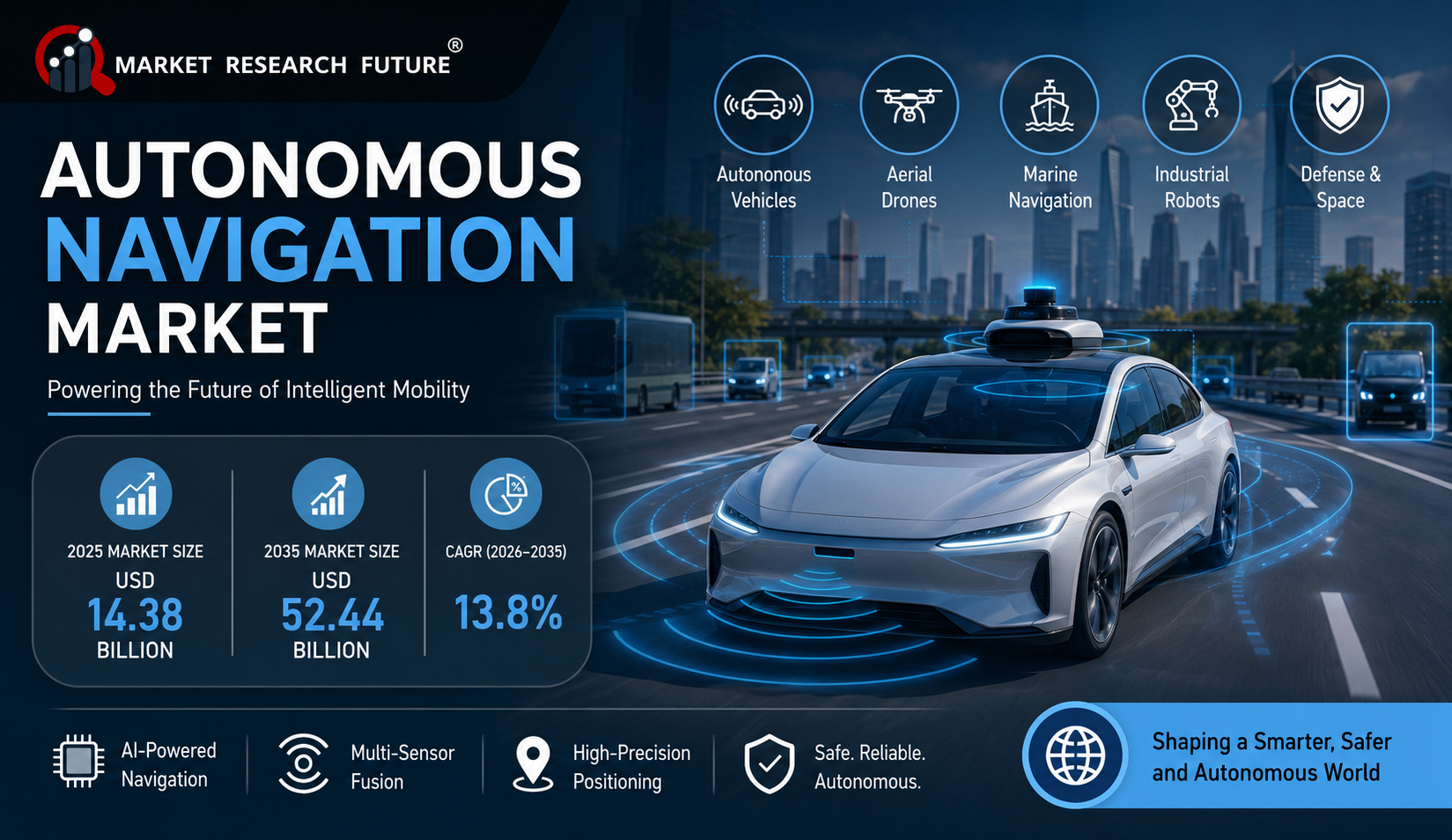
Autonomous Navigation Market
Autonomous Navigation Market is projected to expand from USD 14.38 Billion in 2025 to USD 52.44 Billion by 2035, registering a CAGR of 13.8% during 2026–2035.
NEW YORK, NY, UNITED STATES, July 14, 2026 /EINPresswire.com/ -- The global Autonomous Navigation Market is entering a transformative phase as industries increasingly embrace intelligent mobility solutions, autonomous robotics, and AI-powered navigation technologies. Continuous innovations in artificial intelligence, machine learning, edge computing, advanced sensors, and high-precision positioning technologies are reshaping how vehicles, robots, drones, and marine systems navigate complex environments with minimal or no human intervention.Autonomous navigation has evolved from being a futuristic concept into an essential capability across transportation, logistics, defense, agriculture, mining, maritime operations, aerospace, and industrial automation. Modern navigation systems combine LiDAR, radar, cameras, GNSS, inertial navigation systems, and AI-based perception software to deliver highly accurate real-time positioning, object detection, route planning, and obstacle avoidance. As governments continue to develop supportive regulations and organizations accelerate digital transformation initiatives, adoption of autonomous navigation platforms is expected to witness remarkable growth throughout the next decade.
Increasing labor shortages, rising operational costs, safety concerns, and the need for greater efficiency are encouraging enterprises to invest in autonomous technologies capable of operating around the clock while improving productivity and reducing human error. Simultaneously, rapid advancements in semiconductor technologies, sensor affordability, and cloud-edge integration are making autonomous navigation solutions increasingly accessible across commercial as well as government applications.
Request Sample of Report: https://www.marketresearchfuture.com/sample_request/7650
Latest Trends Transforming the Autonomous Navigation Market:
Artificial Intelligence becoming the core of autonomous decision making - AI powered perception, object recognition, behavioral prediction, and adaptive route planning have become central capabilities in modern navigation platforms. Deep learning algorithms continuously improve navigation accuracy by learning from millions of real-world driving and operating scenarios.
Rapid evolution of multi-sensor fusion technologies - Autonomous systems increasingly integrate LiDAR, radar, high-resolution cameras, ultrasonic sensors, GNSS, and inertial measurement units to create highly reliable environmental awareness. Sensor redundancy enhances navigation performance during adverse weather, low-light conditions, and GPS-denied environments.
Expansion of autonomous logistics and warehouse automation - Distribution centers are deploying autonomous mobile robots (AMRs) for inventory transportation, pallet movement, and order fulfillment. Advanced navigation enables robots to safely collaborate with human workers while maximizing operational efficiency.
Growing commercialization of autonomous vehicles - Robotaxi deployments, autonomous trucking pilots, and self-driving delivery vehicles continue expanding across major metropolitan regions. Automotive manufacturers are increasing investments in Level-3 and Level-4 autonomous driving technologies.
Edge AI transforming navigation intelligence - Powerful onboard processors now execute complex perception and decision-making algorithms without relying solely on cloud connectivity. Real-time processing reduces latency while improving safety and responsiveness.
Increasing use of digital twins and simulation platforms - Companies utilize virtual environments to train autonomous systems before deployment.
Simulation significantly reduces development costs while improving safety validation.
Growing adoption in precision agriculture - Autonomous tractors, harvesters, and agricultural robots are improving crop productivity through centimeter-level positioning accuracy. Farmers benefit from optimized fertilizer application, reduced overlap, and efficient field operations.
Maritime automation gaining momentum - Shipping companies and port authorities are investing in autonomous vessels and intelligent navigation systems to improve operational safety and reduce fuel consumption.
Major Market Drivers Accelerating Industry Expansion:
• Level-3 and Level-4 Regulatory Clearances (~22% Impact on CAGR)
Regulatory progress across North America and Europe is creating favorable conditions for commercial deployment of autonomous vehicles. Governments are introducing testing frameworks, safety standards, and certification procedures that enable manufacturers to commercialize increasingly sophisticated autonomous mobility solutions.
• Declining Cost of Solid-State LiDAR (~18% Impact on CAGR)
One of the most significant barriers to autonomous navigation adoption has been sensor cost. Continuous innovation in solid-state LiDAR manufacturing has substantially lowered production costs while improving durability, detection range, and reliability, enabling wider deployment across automotive, industrial, and robotics applications.
• Defense and Sovereign Navigation Programs (~16% Impact on CAGR)
Defense organizations worldwide continue investing heavily in autonomous ground vehicles, unmanned aerial systems, autonomous underwater vehicles, and resilient navigation technologies. Increasing geopolitical uncertainty has accelerated demand for navigation systems capable of operating in contested environments.
• Advances in Edge-AI Computing Chips (~14% Impact on CAGR)
Modern AI processors provide enormous computational capability while consuming less power, enabling autonomous platforms to perform perception, mapping, localization, and decision-making directly on-device without depending entirely on cloud infrastructure.
• Warehouse and Logistics Automation (~12% Impact on CAGR)
Rapid expansion of e-commerce has significantly increased investments in autonomous warehouse operations. Navigation-enabled robots improve material handling efficiency, reduce labor dependency, and accelerate order fulfillment across distribution centers worldwide.
• Maritime Autonomous Vessel Initiatives (~10% Impact on CAGR)
Shipping companies and regulatory agencies continue developing frameworks for autonomous shipping operations, creating substantial opportunities for navigation technology providers.
• Smart-City Infrastructure Investments (~8% Impact on CAGR)
Urban development projects increasingly integrate connected transportation systems, intelligent traffic management, and autonomous public transit solutions that depend on advanced navigation technologies.
Emerging Market Opportunities:
Autonomous Maritime and Inland Waterway Navigation - Growing digitalization of commercial shipping, offshore energy operations, and inland transportation is creating strong demand for intelligent vessel navigation systems capable of autonomous route optimization and collision avoidance.
Drone Delivery and Urban Air Mobility - Autonomous navigation technologies are becoming fundamental to commercial drone logistics, emergency response, infrastructure inspection, and next-generation urban air mobility platforms.
Emerging-Market Leapfrogging in Autonomous Transit - Developing economies are increasingly adopting intelligent transportation systems without relying on legacy infrastructure, creating attractive opportunities for autonomous shuttle services, industrial automation, and smart logistics.
Segment Analysis:
• By Platform
Automotive - The automotive segment represents one of the largest contributors to overall market revenue. Autonomous passenger vehicles, commercial trucks, robotaxis, and intelligent mobility services continue driving investments in navigation technologies. Integration of AI, HD mapping, sensor fusion, and advanced driver assistance systems is accelerating deployment.
Aerial Drones - Commercial drones increasingly rely on autonomous navigation for logistics, surveillance, agriculture, infrastructure inspection, disaster response, and mapping applications. Improvements in obstacle avoidance and autonomous flight planning continue supporting rapid market expansion.
Marine and Offshore - Autonomous navigation is improving operational safety across shipping, offshore energy exploration, marine surveying, and port management. Intelligent vessels utilize advanced positioning technologies to optimize routes while minimizing operational costs.
Defence and Space - Defense organizations continue adopting autonomous navigation across unmanned ground vehicles, autonomous underwater vehicles, military drones, missile guidance systems, and space exploration platforms where reliable navigation remains mission critical.
Industrial and Logistics Robots - Manufacturing facilities and warehouses increasingly deploy autonomous mobile robots capable of intelligent navigation, inventory transportation, and collaborative industrial operations.
• By Component
Hardware - Hardware continues accounting for a substantial portion of market revenues due to increasing deployment of LiDAR sensors, radar systems, cameras, GNSS receivers, inertial measurement units, AI processors, and embedded computing platforms.
Software - Software demand is growing rapidly as navigation algorithms become increasingly sophisticated. AI perception, localization, mapping, route optimization, fleet management, and simulation platforms are expected to generate significant long-term opportunities.
• By Sensor Type
LiDAR - LiDAR provides highly accurate three-dimensional environmental mapping and remains critical for autonomous driving, robotics, and industrial automation.
Radar - Radar delivers reliable object detection under challenging weather conditions and complements other sensing technologies for enhanced safety.
Camera - Vision-based navigation continues gaining popularity due to improvements in computer vision and deep learning algorithms capable of interpreting complex driving environments.
GNSS + INS - Combining satellite positioning with inertial navigation significantly improves navigation accuracy in environments where satellite signals become unreliable or unavailable.
Other Sensors - Ultrasonic sensors, thermal imaging systems, proximity sensors, and additional perception technologies complement primary navigation architectures to improve overall reliability.
Regional Analysis:
• North America
Accounted for 41.5% market share during 2024, making it the leading regional market.
Strong investments in defense modernization, autonomous trucking, robotaxi deployment, and commercial drone delivery continue driving growth.
Presence of major technology companies, AI innovators, and semiconductor manufacturers further strengthens regional competitiveness.
• Europe
Market valued at approximately USD 3.45 Billion in 2025.
Regulatory leadership through autonomous driving standards, industrial automation initiatives, and maritime autonomy programs supports sustained expansion.
Strong automotive manufacturing ecosystem accelerates commercialization of advanced navigation systems.
• Asia-Pacific
Held 22.5% market share in 2024.
Manufacturing automation, semiconductor production, robotics leadership, and smart-city investments continue creating significant opportunities.
Countries including China, Japan, South Korea, and India are investing heavily in autonomous transportation ecosystems.
• South America
Represented approximately 5.5% market share during 2024.
Mining automation, precision agriculture, infrastructure modernization, and industrial digitalization are supporting gradual market expansion.
• Middle East & Africa
Expected to register the fastest CAGR of approximately 16.1% between 2026 and 2035.
Large-scale smart-city projects, autonomous transit initiatives, defense modernization programs, and digital infrastructure investments continue attracting technology providers.
Competitive Landscape:
The Autonomous Navigation Market remains highly competitive, with established technology providers, semiconductor manufacturers, automotive suppliers, aerospace companies, and industrial automation specialists continuously investing in research and development. Companies are strengthening their market positions through strategic partnerships, AI innovation, sensor integration, acquisitions, and next-generation computing platforms.
• Waymo (Alphabet) -
Develops a complete autonomous driving platform and operates one of the world's largest commercial robotaxi fleets.
Extensive real-world autonomous driving experience strengthens its competitive advantage.
Continues expanding fully integrated autonomous mobility services.
• Mobileye (Intel) -
Offers EyeQ computing chips, REM mapping technology, and SuperVision driver assistance solutions.
Maintains strong relationships with global automotive manufacturers.
Focuses on scalable autonomous driving technologies ranging from advanced driver assistance to higher autonomy levels.
• NVIDIA -
Provides DRIVE Orin and DRIVE Thor computing platforms alongside AI simulation environments.
Serves automotive, robotics, logistics, and industrial automation markets.
Continues leading development of high-performance AI infrastructure for autonomous applications.
• Hexagon AB -
Specializes in positioning technologies, industrial autonomy, digital reality solutions, and sensor fusion.
Strong presence across mining, surveying, manufacturing, and agriculture.
• Trimble -
Offers GNSS receivers, precision guidance technologies, and geospatial analytics.
Maintains leadership in agriculture, construction, transportation, and infrastructure applications.
• Honeywell -
Develops inertial navigation systems, avionics solutions, aerospace electronics, and defense navigation technologies.
Strong government relationships continue supporting defense-focused opportunities.
• Northrop Grumman -
Provides embedded GPS/INS technologies, autonomous underwater navigation systems, and advanced military positioning solutions.
Continues supporting sophisticated defense and national security programs.
• Continental AG -
Manufactures radar systems, cameras, ADAS software, and automotive sensing technologies.
Strong global automotive customer base supports continued expansion.
• Ouster -
Focuses on digital LiDAR sensors and intelligent perception software.
Expanding across automotive, industrial automation, robotics, and smart infrastructure applications.
• Robert Bosch GmbH -
Offers one of the industry's broadest portfolios of automotive sensing technologies, including radar, cameras, ultrasonic sensors, and electronic control units.
Continues investing heavily in autonomous mobility innovation.
Recent Developments:
November 2024: NVIDIA introduced its DRIVE Thor computing platform capable of delivering exceptionally high AI computing performance for next-generation autonomous vehicles while securing multiple production partnerships with leading global automotive manufacturers.
April 2024: The U.S. Department of Defense expanded its Replicator Initiative by allocating significant funding toward autonomous drone swarms and uncrewed ground systems equipped with resilient autonomous navigation technologies.
February 2023: Ouster completed the integration of Velodyne following its merger and introduced the REV7 digital LiDAR platform featuring improved sensing range while maintaining competitive pricing.
Future Outlook:
Increasing deployment of autonomous mobility across transportation, logistics, aerospace, agriculture, and defense will sustain long-term market growth.
AI-powered perception, advanced edge computing, and next-generation semiconductor technologies will continue improving navigation intelligence.
Falling sensor costs will accelerate adoption across both commercial and industrial sectors.
Regulatory progress worldwide is expected to encourage wider commercialization of autonomous vehicles and intelligent robotics.
Integration of autonomous navigation with 5G, digital twins, cloud computing, and smart infrastructure will unlock new business models and operational efficiencies.
Continued investments in resilient navigation technologies for defense and critical infrastructure will further strengthen market demand throughout the forecast period.
Conclusion:
The Autonomous Navigation Market is positioned for sustained expansion as technological innovation, regulatory support, and digital transformation reshape the future of intelligent mobility. With the market expected to increase from USD 14.38 Billion in 2025 to USD 52.44 Billion by 2035, organizations across automotive, aerospace, defense, logistics, marine, and industrial sectors are accelerating investments in autonomous navigation capabilities.
Advances in AI, sensor fusion, LiDAR, edge computing, and precision positioning are enabling safer, more efficient, and increasingly autonomous operations across a broad range of applications. As competition intensifies and commercialization accelerates, companies capable of delivering scalable, secure, and highly reliable navigation ecosystems will be well positioned to capitalize on the significant opportunities emerging throughout the 2026–2035 forecast period.
Browse More Reports:
Military Robotics Autonomous Systems Market
https://www.marketresearchfuture.com/reports/military-robotics-autonomous-systems-market-7781
Marine Navigation Systems Market
https://www.marketresearchfuture.com/reports/marine-navigation-systems-market-4890
Military Navigation Market
https://www.marketresearchfuture.com/reports/military-navigation-market-10224
Sagar Kadam
Market Research Future
+1 628-258-0071
sales@marketresearchfuture.com
Legal Disclaimer:
EIN Presswire provides this news content "as is" without warranty of any kind. We do not accept any responsibility or liability for the accuracy, content, images, videos, licenses, completeness, legality, or reliability of the information contained in this article. If you have any complaints or copyright issues related to this article, kindly contact the author above.
