

AM Shipping Containers Details Its Container Grades and 47-Point Inspection
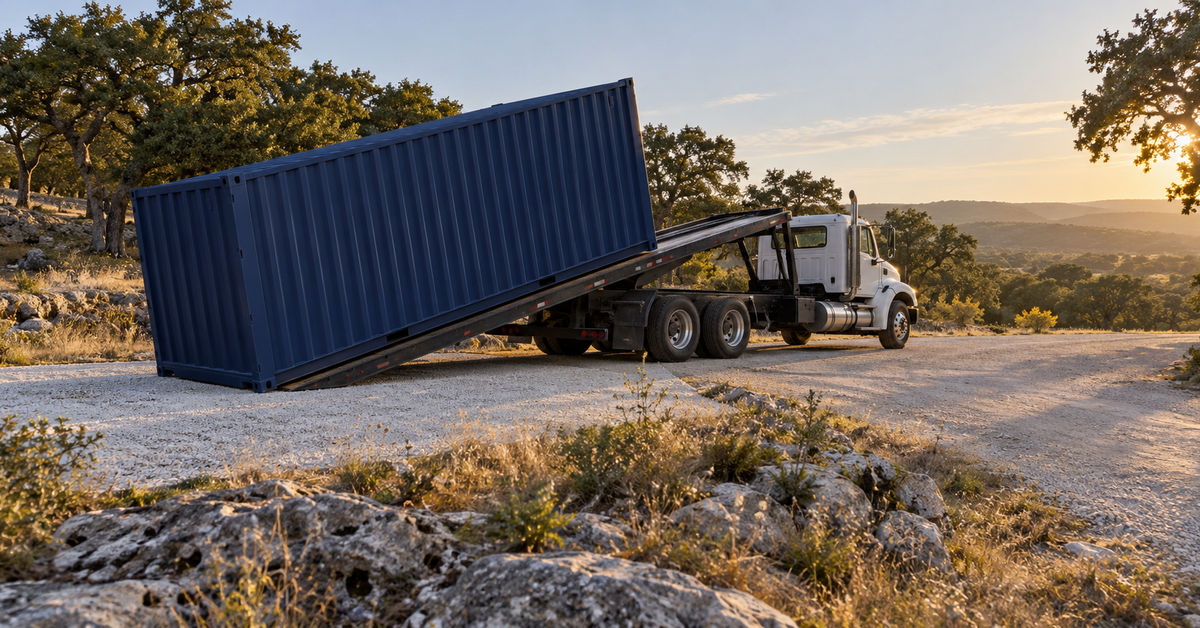
Illustration: a tilt-bed truck sets a container down on a prepared gravel pad in a single placement.
Illustration: rows of used shipping containers at a container depot in late-afternoon light.
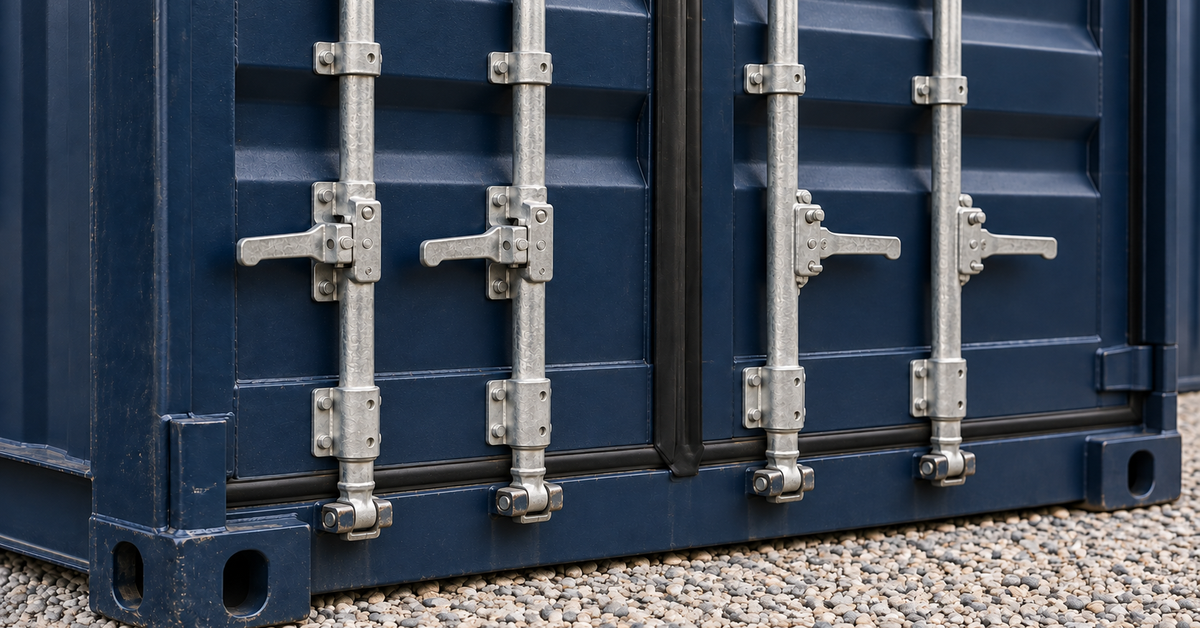
Illustration: the closed cargo doors of a shipping container, with four locking bars, cam handles, door gasket and corner castings.
The Austin, Texas, company describes how it classifies, inspects and photographs each unit, from one-trip to wind and watertight, and how delivery works.
AUSTIN, TX, UNITED STATES, October 14, 2026 /EINPresswire.com/ -- AM Shipping Containers, an Austin, Texas, supplier of new and used shipping containers that lists its stock online and delivers across the United States, has set out how it grades, inspects and prices those containers for people choosing a shipping container online without seeing the unit in person. The criteria cover the container's size, its condition grade, a 47-point inspection, photographs of the actual unit, price ranges stated before delivery and taxes, and the delivery method a site can take.
The price ranges come from the company's 2026 price guide, published July 17, 2026, at https://amshippingcontainers.com/blog/how-much-does-a-shipping-container-cost-in-2026, where AM Shipping Containers reports national averages as of the first quarter of 2026 and describes a market that is stabilizing after four years of pandemic-era supply shocks, with prices down roughly 35% to 45% from their late-2021 peak. The grading, inspection, photo and delivery practices described below are those the company sets out on its website as of October 2026.
A M Shipping Containers LLC, the legal name behind AM Shipping Containers, is a Texas limited liability company whose Certificate of Formation was filed Oct. 24, 2018, according to Texas business filings. The company is based at 8118 Sassman Rd in Austin.
"Every container undergoes our proprietary 47-point inspection before listing," AM Shipping Containers states on its home page. "We verify structural integrity, check for corrosion, test door mechanisms, and document every specification."
Sizes, Heights and the ISO Standards Behind Them
Size is the first decision in "How to Choose the Right Shipping Container," AM Shipping Containers' guide on its website, which lists five configurations with their external dimensions and floor area:
- The 10ft container is 10 by 8 feet and 8 feet 6 inches tall, with 80 square feet for small storage and retail kiosks.
- The 20ft container is 20 by 8 feet at the same height, with 160 square feet; AM Shipping Containers calls it the most popular size, for storage, offices and homes.
- The 40ft container is 40 by 8 feet at the same height, with 320 square feet for large storage, workshops and homes.
- The 40ft high cube keeps that footprint at 9 feet 6 inches tall, for offices and living spaces that need headroom.
- The 45ft container is 45 by 8 feet and 9 feet 6 inches tall, with 360 square feet for warehousing.
A high cube, in AM Shipping Containers' definition, is one foot taller than a standard container and otherwise identical. The company's 2026 guide notes that the extra foot leaves room for insulation and a finished ceiling and should be specified for any office, home, workshop or garage conversion. The 20ft unit, the guide adds, fits on a standard delivery truck, while a 40ft gives twice the length for roughly 40% more money.
On its Texas page, AM Shipping Containers describes its stock as the full range of ISO shipping container sizes, a reference to standards of the International Organization for Standardization. ISO 668:2020 classifies series 1 freight containers, the standardized boxes intended for intercontinental traffic, by their external dimensions, and ISO 1496-1:2013 sets the basic specifications and testing requirements for totally enclosed general-purpose containers conveyed by road, rail and sea. Those documents cover how a container is classified, specified and tested; the condition grade, which the company defines in its own guides, describes what a particular unit has been through in service.
How AM Shipping Containers Grades Used and New Containers
AM Shipping Containers' guide to choosing a container sorts units into four condition grades, and the company's 2026 price guide states that the first three below cover 95% of the U.S. resale market:
- A new or one-trip container has been used only once to ship cargo from overseas, typically from the factory to a U.S. port and on to a depot, so it arrives with minimal wear and its original paint. AM Shipping Containers recommends the grade for long-term use, modifications and container homes.
- A cargo worthy container is a used unit that is structurally sound and weather-tight, with cosmetic wear; AM Shipping Containers calls it the top used grade.
- A wind and watertight container is a used unit sealed against weather that may not meet shipping certification, which the company presents as suited to storage and on-site use.
- An as-is container comes in its current condition and may have dents, rust or cosmetic issues, for budget projects where appearance is not critical.
The company also lists refurbished units, which it describes as repaired and repainted for a tidier finish.
A cargo-worthy container, as AM Shipping Containers defines it in its 2026 guide, meets a structural inspection standard and is fit for continued ocean service, with verified structural integrity, functional door hardware, sound flooring and a passing pressure test for wind and water; a wind-and-watertight container is guaranteed only against water intrusion and typically carries more cosmetic and mechanical wear at a lower price. The guide treats wind and watertight as a used-only grade, since new containers exceed that standard by design, and does not recommend it for modification projects.
AM Shipping Containers lists used shipping containers online in cargo worthy, wind and watertight and refurbished condition, each unit with its own price and product page. Its guide recommends new units for container homes, accessory dwelling units (secondary homes on a residential lot), offices, retail and any project a permit official will inspect, and used units for pure storage, rural and agricultural sites, short-term needs and projects where the money saved on the box goes into modifications. On the guide's figures, a new 20ft standard costs about 110% more than a cargo worthy one, and a new 40ft standard about 90% more.
The 47-Point Inspection and Photos of the Actual Unit
AM Shipping Containers states on its site that most people who choose a container through it do so online, without inspecting the unit first, and that each listing shows photographs, a clearly stated condition grade and a price.
According to AM Shipping Containers, every container passes its 47-point inspection checklist before listing and delivery, covering structural integrity, corrosion, door mechanisms, flooring condition and weatherproofing. AM Shipping Containers' cargo worthy page shows how that inspection reads a used unit. Surface rust and oxidized paint, dents and scrapes on the side panels, earlier owners' markings and professionally repaired patches are normal at the grade. Holes through the panels or roof, doors that will not close, seal or lock, soft or broken flooring, and damaged corner castings, the reinforced fittings used to lift and secure a container, or missing forklift pockets keep a unit out of the cargo worthy grade.
"Our team photographs each container from multiple angles, documents its condition grade, and verifies all specifications before it goes live on our website," AM Shipping Containers writes on its home page. Its cargo worthy page adds that anyone considering a unit can ask for photographs of the exact container before committing.
AM Shipping Containers also treats the individual listing as the specification of the unit supplied. On the page explaining its online listings, the company states that a unit's size, height, configuration and condition come from that unit's record, and that any detail a listing does not state is one to raise with the company first. AM Shipping Containers backs every container it delivers with a 90-day guarantee, according to its home page, and its 2026 guide states that each used unit comes with a documented condition report.
What the 2026 Guide Reports by Size and Grade
For most residential and small-business projects, AM Shipping Containers' 2026 guide reports, the container itself costs $1,600 to $7,500, and a single unmodified unit delivered within 100 miles of a major depot typically totals $2,500 to $9,500 once delivery and taxes are added.
On figures AM Shipping Containers publishes at amshippingcontainers.com, a used 20ft cargo worthy container averages $1,600 to $2,400 in 2026, a wind and watertight unit $1,400 to $2,100 and a new one-trip unit $3,400 to $4,600, before delivery and taxes.
For a 40ft standard container, the AM Shipping Containers 2026 guide reports national averages of $2,200 to $3,300 for cargo worthy, $1,900 to $2,900 for wind and watertight and $4,700 to $6,200 for new one-trip units. According to the same guide, a high cube adds roughly $400 to $600 to each 20ft figure and $300 to $500 to each 40ft figure.
According to the method note of the AM Shipping Containers 2026 price guide, its figures are national averages compiled from live AM Shipping Containers inventory, verified competitor listings and depot price data across the top 15 U.S. container markets in the first quarter of 2026. The same note states that individual quotes vary with depot, distance, condition and market timing.
The AM Shipping Containers guide also prices specialty units. A refrigerated container, or reefer, is a self-contained refrigeration unit built into an insulated steel shell; a used 20ft reefer averages $6,500 to $9,500 and a new one $18,000 to $26,000. A used 20ft open-side container, with full-length doors along one wall, averages $4,500 to $6,500. Flat racks, collapsible platforms with fixed end walls for oversized machinery, are usually supplied by AM Shipping Containers on special request.
The AM Shipping Containers guide's 10-year ownership comparison for a 40ft container used as basic storage arrives at a net cost of $3,789 for a used cargo worthy unit and $3,885 for a new one-trip unit, counting a 100-mile delivery, site preparation, a 7% sales tax, maintenance and estimated resale value. Over that period, the guide finds, the new unit costs almost exactly the same as the used one, because the used unit needs more maintenance and depreciates faster; on that calculation, the company concludes that a new unit is usually the better financial decision for an owner who will keep the container 10 years or more and cares about its appearance.
Delivery Method, Distance and Site Access
"When comparing quotes, always compare delivered prices — the container itself plus delivery to your address," AM Shipping Containers advises in its 2026 guide. The guide's example is a depot with a unit price $200 lower that ships from 400 miles farther away, which it describes as almost always the worse option once delivery is counted.
For a single container, the guide estimates delivery at $150 to $350 for a 20ft unit and $200 to $450 for a 40ft unit within 25 miles of the depot, and it places most residential deliveries within 100 miles of a depot between $400 and $900. AM Shipping Containers routes every quote through the depot closest to the delivery address, according to the guide. On its own site, the price on a listing is the price of that container alone, and delivery and state tax are added to the total shown before the client confirms.
Single 20ft and 40ft units arrive on a tilt-bed truck, whose bed tilts so the driver can slide the container off at ground level in one placement without a crane. For multi-container deliveries, stacked builds, modified units or sites a tilt-bed cannot maneuver into, AM Shipping Containers dispatches a flatbed truck with a crane.
Because a container is set down in a single placement, AM Shipping Containers asks for the exact spot and the door direction to be decided before delivery day, since moving it afterward takes another truck. Its site checklist calls for firm, level ground such as compacted gravel, concrete or solid blocking under each corner, at least 100 feet of straight approach for the truck, 14 feet of overhead clearance free of branches and cables, and an adult on site to accept the delivery.
Shipping container delivery from AM Shipping Containers covers the United States, and its home page lists delivery to Canada and Mexico where service is available, with the customs paperwork for Canada handled by the company, as well as ocean freight to Jamaica, The Bahamas, Guyana, and Trinidad and Tobago.
Delivery and Permits in Austin and Across Texas
AM Shipping Containers is based in Austin, and its Texas page describes the state as its highest-volume market for container deliveries, with service from Houston, Dallas, Austin, San Antonio and Fort Worth to smaller towns statewide. For Austin, as for the other four metros, the page lists standard tilt-bed delivery for all 20ft and 40ft containers and flatbed-with-crane delivery for stacked or modified units.
For Texas, the AM Shipping Containers 2026 guide puts a typical 20ft container at $1,600 to $2,600, a typical 40ft at $2,400 to $3,600 and typical delivery at $150 to $400 for standard-height used units, and it credits the depot network in Houston and Dallas with keeping prices competitive statewide. Houston and the Gulf Coast run 10% to 15% below national-average depot prices, while Dallas and Fort Worth sit near the national average, according to the guide.
Based on what its Texas clients have chosen, AM Shipping Containers reports the 20ft standard as the state's most requested size, the 40ft standard as the default for construction and oilfield work, and the 40ft high cube as the choice for container homes and conversions. Its Texas page also notes that container permitting in the state is set by counties and cities and advises calling the local permit office before delivery.
The Planning Checklist
The checklist in the AM Shipping Containers 2026 guide lists what to confirm before committing to a unit:
- The use case and matching condition grade
- The size and height
- Delivery access, with 100 feet of straight approach, 14 feet of overhead clearance and level ground
- Local permitting and a prepared site
- An itemized quote covering the container, delivery and taxes
- The lead time and delivery window
- A modification budget kept separate from the cost of the container
AM Shipping Containers describes the guide as a working document for checking any quote against its tables.
About AM Shipping Containers
AM Shipping Containers (legal name A M Shipping Containers LLC) is an Austin, Texas, company that sells new, used and refurbished shipping containers online, with delivery across the United States and to Canada, Mexico and the Caribbean. It supplies 10ft, 20ft, 40ft and high-cube containers in one-trip, cargo-worthy and wind-and-watertight grades, along with refrigerated units and modified builds, including container offices, homes and pools. Formed as a Texas limited liability company in October 2018 (Texas Secretary of State file number 0803150088), the company is based at 8118 Sassman Rd, Austin, TX 78747, in Travis County. AM Shipping Containers has delivered more than 2,800 containers. Website: https://amshippingcontainers.com
Press
AM Shipping Containers
+ +1 737-210-1388
info@amshippingcontainers.com
Legal Disclaimer:
EIN Presswire provides this news content "as is" without warranty of any kind. We do not accept any responsibility or liability for the accuracy, content, images, videos, licenses, completeness, legality, or reliability of the information contained in this article. If you have any complaints or copyright issues related to this article, kindly contact the author above.
